Research
I am a postdoctoral research scientist at the University of Vienna in the Climate Dynamics group lead by Aiko Voigt, which is part of the Meteorology and Geophysics Department. I’ve joined the group in May 2025 after finishing my PhD at Wageningen University late September 2024.
My main research interests are clouds, radiation, and deep convection, which I am exploring at the intersection between weather and climate. I am also broadly interested in (extreme) weather, and like to combine observations and modelling in my work. Currently, I am focusing on how overlapping clouds, in particular mid-level clouds overlapping with (anvil) cirrus in the tropics, affect the cloud lifetime of either or both cloud layers.
Below you can find a few specific research interests/expertises described in some more detail. A list of publications can be found here.
Mid-level clouds and cloud overlap
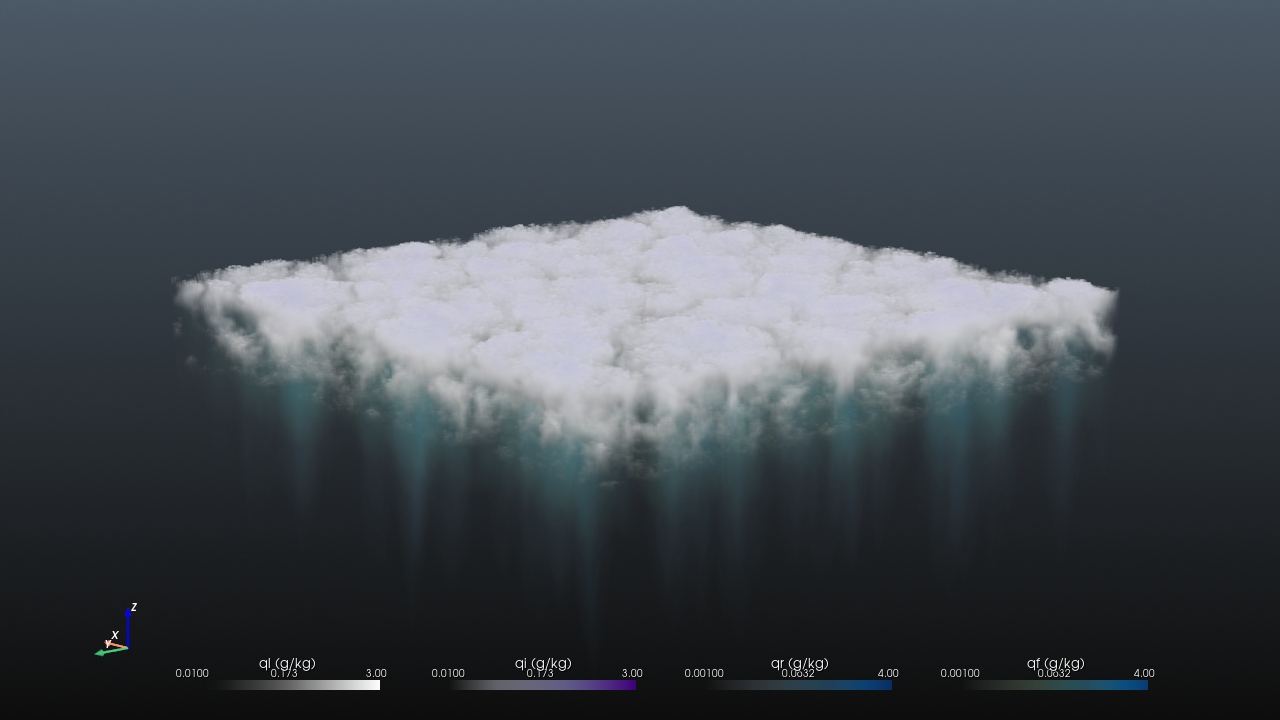
Simulation output of a precipitating mid-level cloud layer
Cloud profiling radars and lidar, on board satellites or on land, reveal the common ocurrence of clouds in the middle troposphere, commonly underlying cirrus clouds or overlying low level clouds.
There are, broadly speaking, two types mid level clouds that I am interested in. One type is the stratiform radiatively driven cloud layers, called altocumulus (see picture). The other type is the congestus cloud, which, in the tropics, is a moisture source of altocumulus as it detrains in the mid levels.
In going work, I am trying to understand the role of these mid level clouds through two perspectives, focusing initially on the Tropics.
First, their direct radiative impact on overlapping cloud layers (often, this is cirrus).
Second, their indirect impact on deep convection and atmospheric circulation due to modifications to atmospheric lapse rate.
Surface solar irradiance variability
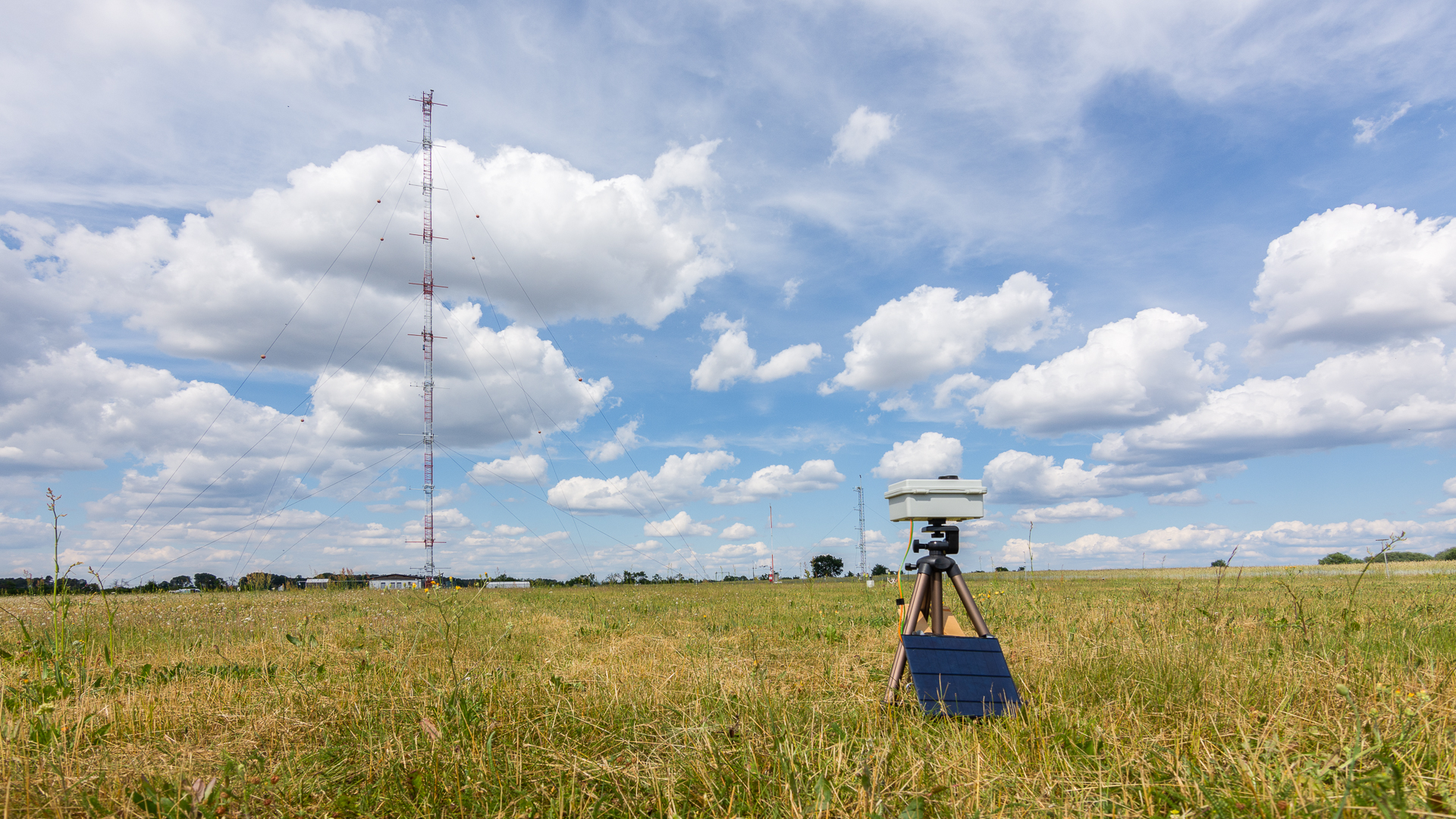
Measuring spectral solar irradiance during FESSTVaL
Solar irradiance at the surface varies on spatiotemporal scales as small as seconds or tens of meters. Clouds, especially broken cloud conditions, are the main cause of this variability. Solar energy production, photosynthesis, cloud formation itself, and many more processes are (in)directly affected. No climate model, not even the highest resolution weather prediction model, resolves these details.
I have spend my PhD observing, modelling, and understanding how (broken) cloud cover affects surface solar irradiance as part of the Shedding light on clouds shadows project. You can find the thesis here, which includes a summary of main findings. One of the cooler things, in my opinion, are the custom made spectrometers that we deployed at the FESSTVaL field campaign, the power-law distribution of cloud shadow sizes, and the 3D Monte-Carlo ray tracing used to support the idea that you need only up to four mechanisms to explain any observed solar irradiance pattern given a cloud type.
Weather, deep convection, and data visualization
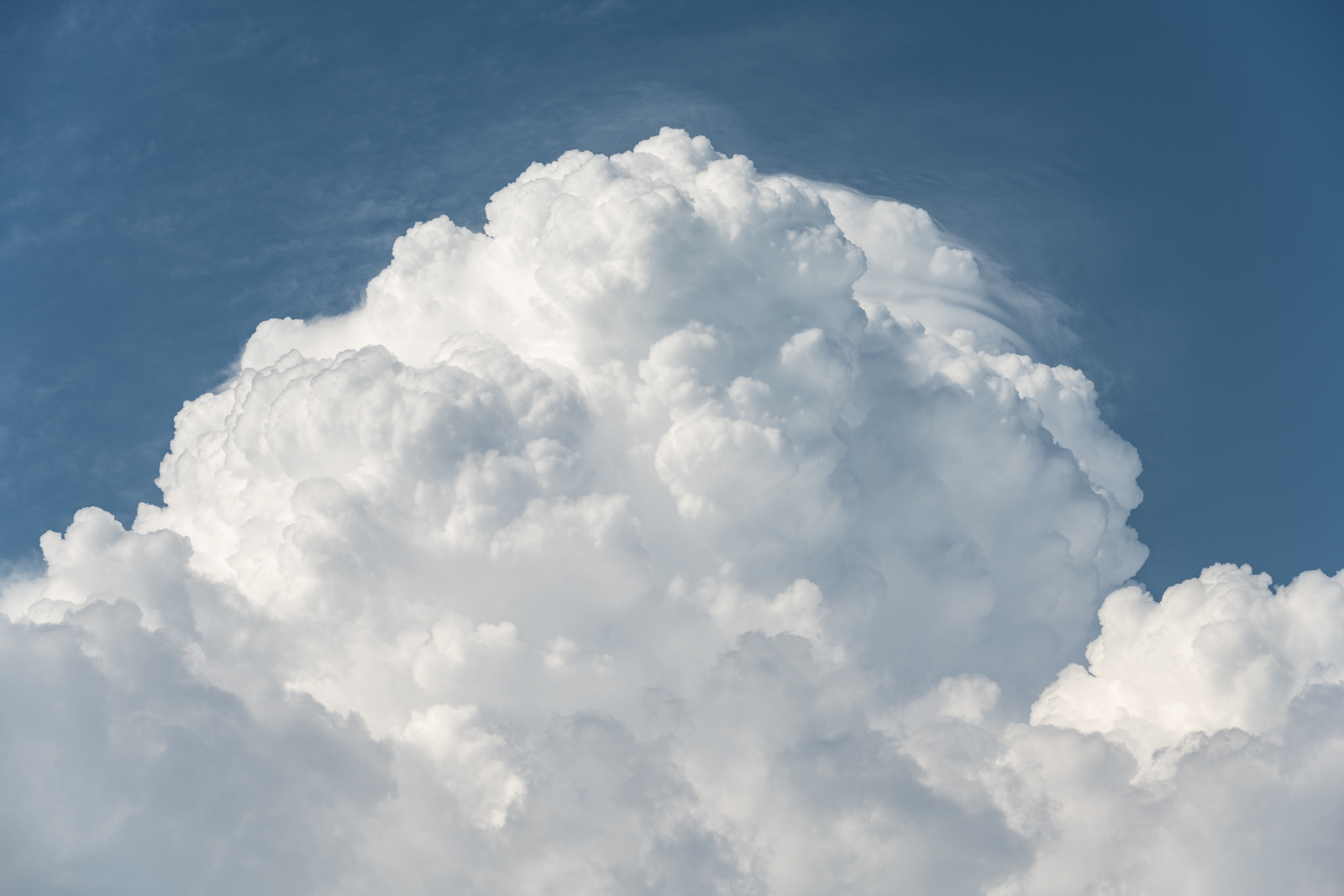
A strong convective updraft with pileus formation above
Thunderstorms and other types of extreme weather are what originally got me interested in studying weather and climate.
In much of my work, you will find some connection to this interest.
I’m currently exploring ideas in the direction of extreme hothouse climates, which show an apparent periodic deluge type of precipitation, and (3D) radiative impacts on convective storm motion. Additionally, because I enjoy data visualization and I think it helps with understanding model output, I’m working on rendering 3D (x,y,z) data of model simulations.
The dream, ultimately, would be to simulate and render an image that looks exactly like the photograph above, made from physically sound data. The main challenge is the spatial resolution required to simulate the texture and detail of a congestus cloud, fit it in a domain large enough to accomodate such an updraft, and represent the microphysics and radiative transfer accurately. See Leigh Orf’s and Menno Veerman’s work for an idea of what is already possible today.
I am a postdoctoral research scientist at the University of Vienna in the Climate Dynamics group lead by Aiko Voigt, which is part of the Meteorology and Geophysics Department. I’ve joined the group in May 2025 after finishing my PhD at Wageningen University late September 2024.
My main research interests are clouds, radiation, and deep convection, which I am exploring at the intersection between weather and climate. I am also broadly interested in (extreme) weather, and like to combine observations and modelling in my work. Currently, I am focusing on how overlapping clouds, in particular mid-level clouds overlapping with (anvil) cirrus in the tropics, affect the cloud lifetime of either or both cloud layers.
Below you can find a few specific research interests/expertises described in some more detail. A list of publications can be found here.
Mid-level clouds and cloud overlap
Simulation output of a precipitating mid-level cloud layer
Cloud profiling radars and lidar, on board satellites or on land, reveal the common ocurrence of clouds in the middle troposphere, commonly underlying cirrus clouds or overlying low level clouds.
There are, broadly speaking, two types mid level clouds that I am interested in. One type is the stratiform radiatively driven cloud layers, called altocumulus (see picture). The other type is the congestus cloud, which, in the tropics, is a moisture source of altocumulus as it detrains in the mid levels.
In going work, I am trying to understand the role of these mid level clouds through two perspectives, focusing initially on the Tropics. First, their direct radiative impact on overlapping cloud layers (often, this is cirrus). Second, their indirect impact on deep convection and atmospheric circulation due to modifications to atmospheric lapse rate.
Surface solar irradiance variability
Measuring spectral solar irradiance during FESSTVaL
Solar irradiance at the surface varies on spatiotemporal scales as small as seconds or tens of meters. Clouds, especially broken cloud conditions, are the main cause of this variability. Solar energy production, photosynthesis, cloud formation itself, and many more processes are (in)directly affected. No climate model, not even the highest resolution weather prediction model, resolves these details.
I have spend my PhD observing, modelling, and understanding how (broken) cloud cover affects surface solar irradiance as part of the Shedding light on clouds shadows project. You can find the thesis here, which includes a summary of main findings. One of the cooler things, in my opinion, are the custom made spectrometers that we deployed at the FESSTVaL field campaign, the power-law distribution of cloud shadow sizes, and the 3D Monte-Carlo ray tracing used to support the idea that you need only up to four mechanisms to explain any observed solar irradiance pattern given a cloud type.
Weather, deep convection, and data visualization
A strong convective updraft with pileus formation above
Thunderstorms and other types of extreme weather are what originally got me interested in studying weather and climate. In much of my work, you will find some connection to this interest.
I’m currently exploring ideas in the direction of extreme hothouse climates, which show an apparent periodic deluge type of precipitation, and (3D) radiative impacts on convective storm motion. Additionally, because I enjoy data visualization and I think it helps with understanding model output, I’m working on rendering 3D (x,y,z) data of model simulations.
The dream, ultimately, would be to simulate and render an image that looks exactly like the photograph above, made from physically sound data. The main challenge is the spatial resolution required to simulate the texture and detail of a congestus cloud, fit it in a domain large enough to accomodate such an updraft, and represent the microphysics and radiative transfer accurately. See Leigh Orf’s and Menno Veerman’s work for an idea of what is already possible today.