How to be a scientist in the age of AI
There is a fundamental shift ongoing in the way science is done, and it is changing what it means to be a scientist. Opinions and expectations for what the future holds span a wide range, from pessimism and fear to over-enthusiasm and tech-utopia. Here, I will discuss some of the main perceived threats to science based on many recent discussions, lots of experimentation, and digesting thoughtful content. Hopefully it will be of some use. Please reach out if you have questions or comments.
Some clarifications before I start:
- Science in this post refers to the more academic, non-economic, or fundamental science, typically found at universities. Industrial science, engineering, and whatever the AI labs are trying to do serve a different purpose
- AI refers to the LLM-based agents (e.g. Opus 5.5 in Claude Code)
- I can hardly discuss everything and this post is obviously just my view
I will start by arguing why I believe there is a place for universities even in the case that most scientific discovery is automated by intelligent computer systems. Many other problems are related. These are all the problems I will discuss:
1. Big Tech is not aligned with academia
Big AI labs, in particular Anthropic, OpenAI, and Google DeepMind, are increasingly working toward automating scientific discovery using AI models. Fields in which even the most difficult questions have clear, verifiably correct answers are where models appear most capable. Programming and mathematics are the most famous examples, and the “Reinforcement learning with verifiable rewards” training process at the big AI labs is what underpins this progress. Simple extrapolation suggests adjacent fields are next (e.g. theoretical physics, computational biology).
The perceived threat to science, apart from the rate of progress, comes from the fact that these labs have very different incentives for doing science. They’re in a fierce competition to deliver the best models, impress investors, and are under great pressure to deliver returns on the astronomically large investments. Solving hard science problems, it turns out, is an effective way to achieve all those goals, but this happens without much regard for existing societal structures of doing science. See e.g. the controversy around OpenAI’s release of math solutions and its impacts on the math community.
Add to that restricted access to frontier models (e.g. Mythos) or their capabilities (“guardrails” in biology, information security, AI research), the difference in compute between the AI labs and independent scientists (1000 parallel agent swarms are out of reach of the public), and many privacy and data security concerns.
The result for science: an external entity that treats science as a benchmark, is clearly becoming capable of solving hard problems, and lets others conditionally use their models at a price that can increase at any time. I personally fear academia can’t adapt fast enough to deal with this new force. How can a PhD student compete with a swarm of agents? Why pay large salaries to experts when a model can solve problems for a few dollars?
Universities: a place for developing understanding
For the foreseeable future, I am convinced we will want people to understand the answers to important questions and people to decide which questions are important. Even in the extreme case that all those answers are generated by computers, we need a way to trust the answers, we need to be able to communicate them among ourselves in terms that make sense to humans, and the findings should be applied in the real world to have any meaningful benefit.
This means society needs experts who can understand complex material and solve difficult problems. Educating and training such experts currently happens mostly at universities, largely free of economic incentives. Bachelor’s and master’s programs (and of course school before that) provide a solid foundation, and further training then continues in industry or academia.
We should probably keep doing that. If not, we will end up with a society run by a very concentrated elite of educated people with smart computers, and hardly anyone who can verify what they say.
And by focusing on education and developing deep understanding, we avoid direct competition with the big AI labs. Let them produce the most capable models and crack major scientific problems they deem important. Let universities independently educate critical thinkers and aim to deeply understand whatever they deem important.
Sovereign AI
For independent science, we will need independent AI. Running open-weight models with (near) frontier capabilities is the obvious long-term solution to the current problem of relying on closed-source and restricted commercial models. Admittedly, this is not possible right now: it is costly and the open-weight models are not as intelligent or fast. We should nevertheless direct efforts toward setting up the infrastructure and be ready to switch once we can.
2. Skill atrophy / “AI brain rot”
Continuing on the assumption that having (many) humans who can understand and do science remains important, it’s time to discuss the most common fear I hear of using AI: skill atrophy. This is the process of unlearning important skills due to offloading difficult tasks to AI, also referred to as cognitive offloading, the end result informally called AI brain rot.
Let’s explore how one can lose the ability to think as an example. Previously, when you had a question you had to work harder for the answer (read a book, a paper, do a calculation, write some code, etc), but now you ask your favorite AI and you get an immediate answer. That’s great for many things, but absolutely disastrous if you need to understand the concept you had a question about, for two reasons:
- You’ve hardly spent any time thinking about it
- You’ve probably asked the wrong question without realizing it
These effects will accumulate over time. If you consistently take the easy route and just ask whenever you don’t know something, you will lose your ability to reason through difficult problems (skill atrophy).
Make it difficult for yourself
Luckily, there is a simple solution to preventing skill atrophy, and it’s nothing new. Ask yourself:
Is it important to understand the answer to this question?
If your answer is yes, tell your AI to use the Socratic Method, i.e., to never give you the straight answer and instead force you to reason through the problem. In this way, you will find what exactly you did not understand (answering subquestions, realizing you made a wrong assumption, etc) and spend considerably longer thinking about what the answer should be. I illustrate that difference in Figure 1 below.
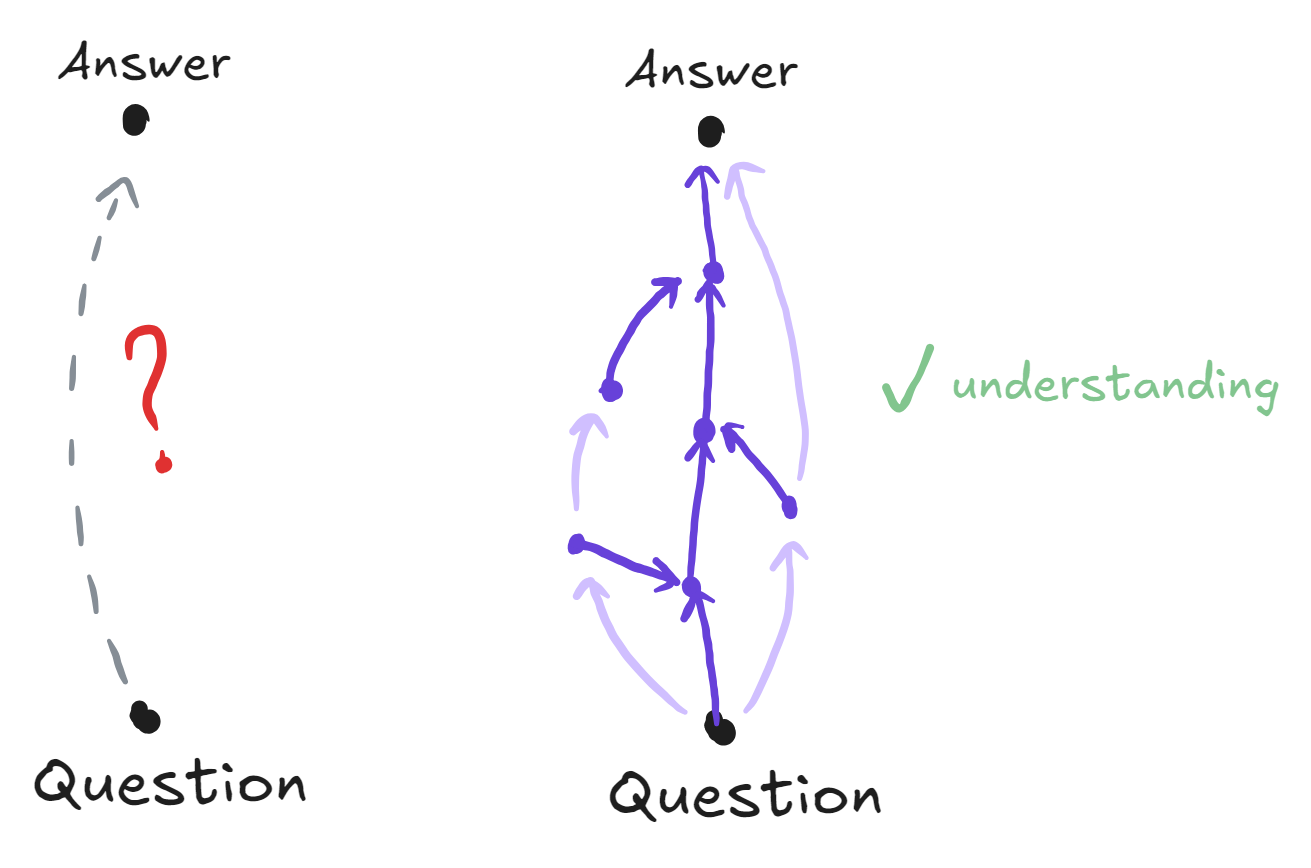
Practically, you can install skills or plugins to have this methodology built into your AI tool. For example, whenever I don’t want a straight answer, I use /socrates, which is an installed skill in Claude Code. You can build it yourself using the /skill-creator plugin, or copy my SKILL.md and adjust if needed.
This concept of making it difficult for yourself generalizes to all other skills you may be afraid of losing when you use AI. The real challenge then is to decide which skills are worth protecting or developing further, and which ones are maybe fine to outsource.
3. “Black box” software design and data analyses
Where AI agents appear most useful, at least in my field of science, is software design and data analyses. Building, modifying, testing, and optimizing (complex) computer model code bases has become much faster and can now be done even by inexperienced programmers. The same goes for data analysis. AI agents happily download and/or process all kinds of data, run advanced statistical analysis, and even attempt to derive insights or theory from the results if you ask them to.
So, what is the problem? It is a lot like skill atrophy: you don’t understand the model or trust the data results if you let the AI agents do all the work. Even if you have a solid and detailed plan, I have found the end result is never satisfactory when you let the AI execute this plan. Either the result is not what you intended, or you don’t understand how the software works, or both.
Break up the problem and work with the AI
The solution to this problem has two steps.
First, when you start on a new analysis or software feature, develop a concrete plan.
I typically write that in a PLAN.md first, without AI.
Then, using a grilling skill, the AI agent and I go through a thorough review and make sure we are aligned.
Typically, this exposes many gaps in my initial plan, or I realize I explained parts wrong.
Now, when the plan is set, do not say “Implement the plan”, wait 1-12 hours, and enjoy the result. Instead, in the basic instructions of your AI agent (e.g. CLAUDE.md), I have the following:
“Only do one step at a time. When a step is done, or when a design decision is to be made, stop, and report back to me.”
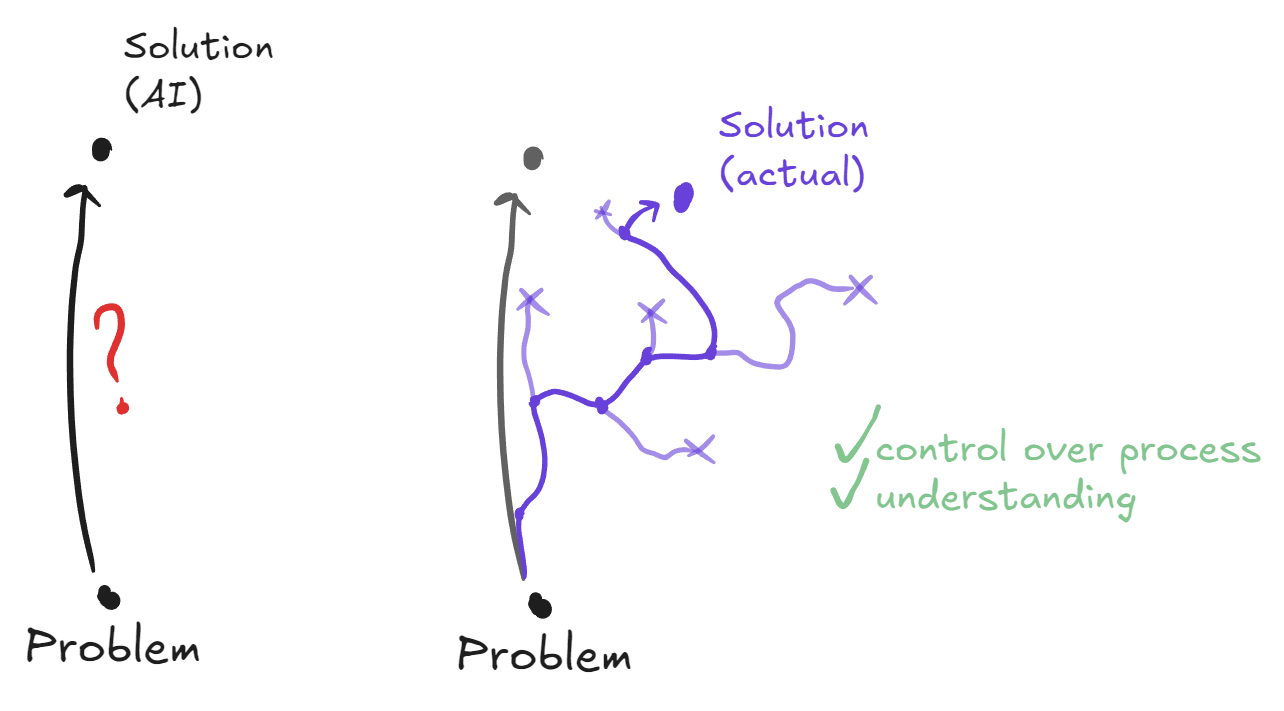
The result is that it will initially take longer to build a model or perform an analysis. However:
- You have come to an end result that is better and more useful than the ‘one-shot’ build
- You understand how the new software works and therefore trust the outcome, know its strengths and weaknesses, and are able to maintain it long-term
As a concrete example, I have been building simple ice cloud models for a workshop and for use in teaching. The first product, after spending 60+ minutes on designing and grilling a plan, took the AI agent a few hours to make, but ended up being useless despite looking visually impressive. The next attempt, where I was involved in cutting up the plan into small pieces and course-correcting along the way, was actually useful. This took more than a full working day, but that was time well-spent (and more fun!).
4. AI generates more work
As it becomes easier to build software, do data analysis, write papers, make animations, etc, you are not actually saving any time. Instead, you will end up doing a lot more of all that if you are not careful. So much so, in fact, that your overall workload ends up increasing. And that’s a problem: there are not suddenly more hours in a day and the quality of whatever you were doing will suffer.
Why the quality of your work suffers relates largely to what I discussed before in the skill atrophy and black box software design sections. You lose understanding and control over the process of producing results, and while your work output in terms of results may increase, you are producing fewer insights. That is the wrong direction, given the importance of developing understanding, unless you wish to compete with computers.
I see three ways people respond to the introduction of AI in this context:
- Ignore it (that’s fine)
- Use it to do more analysis, write more papers, submit more proposals, build more software, more more!
- Do the same amount of work as before, but now go deeper and produce higher quality
I firmly believe option 2 is the wrong way to go, at least for the long term, but it appears to be the default path. Many of us in science are intrinsically curious and now the barrier to follow that curiosity is lower than ever. By all means, go experiment and see what AI is capable of. But you will generate so many results that need to be understood, validated, and communicated, you end up doing nothing useful at all. It’s too easy and it’s counterproductive.
As I believe the focus on academic science has to shift more to generating fundamental understanding, AI should be used to go to much greater depth and raise the overall quality. Both at the individual and broadly scientific level we should create less noise and more signal.
So, just like before AI, I set myself the goal of publishing 1 lead-author paper a year.
5. Loss of joy
I got a great deal of joy and sense of fulfillment from spending hours on creating nice-looking plots in Python. On other days, I could frustratingly spend hours on difficult programming problems in some data analysis project, but then finally get something working, which can only be described as satisfying.
At first, when I realized Opus 5.5 was so good that all these nurtured skills of mine appeared useless, I became rather sad and pessimistic. I’m not alone here: friends and colleagues with certain skill sets that are now matched or overtaken by AI have similar responses.
This will be a real problem for a while. Maybe some jobs are changing into something that the current experts do not like. That is a great loss. It takes a lot of flexibility and energy to adapt and find new sources of everyday fulfillment. For what it is worth, after a few months of pushing Opus 5.5 to its limits, I can say that so far science for me remains as fun as before.
6. Signal vs noise: hiring, grants, publications
Deciding what defines a good paper, which proposals deserve a grant, who to hire for a research position has always been difficult. Certain papers, proposals, or people used to stand out (however subjectively) for a particular reason, for example a very clear communication style or a unique skill set. AI appears to have leveled the playing field in this regard: the floor has been raised and everyone is now at least a decent programmer, writer, etc. Simultaneously, journals and funding bodies are getting flooded with submissions. The result is it’s becoming nearly impossible to separate signal from noise.
I think this will be a matter of adjusting and getting used to it. Like opening the curtains in a dimly lit room when the sun is out, you are first blinded, and after a short while the contrast returns. The light and color are just in different places. We will need to find ways to work with these new tools.
And maybe we can finally improve a system (academia) that everyone has criticized for years anyway.
Summary of advice
I will just leave this summary of my main practical advice here:
- For learning, make the AI question you with the Socratic method
- For software development and data analyses, work with the AI on each step
- To deal with the explosion of results and information: consciously choose depth and quality over quantity
- For the rest: experiment, discuss, and reflect